





Let’s talk about the ballroom…
12 minute read
October 26, 2025, 11:25 PM
Recently, there was a lot of discussion in the news about the demolition of the East Wing of the White House, part of which was built in 1902, and part of which was built in 1942, in order to make way for the proposed White House State Ballroom. My opinions on this entire project are mixed, and I suspect that most people are getting upset about the wrong things, and it also reveals a lot about how little people know about the White House. I happen to know a good bit about the White House, because the White House is one of my special interests. I could read about the White House all day, and fascinate myself with all kinds of details about the structure, the layout, the decor, planned expansions and renovations, etc.
For some history about the area in question, Thomas Jefferson was the first to expand the White House from its original design, adding low-lying colonnades to either side of the White House, in order to connect the Residence with service facilities. The West Colonnade is the original Jefferson-era structure, and now connects the Residence to the West Wing, which houses the Executive Office of the President. Among other things, the West Colonnade houses the Press Briefing Room (so when you see someone standing at the podium in front of that blue “The White House” graphic, that’s in the West Colonnade structure). The East Colonnade connects the Residence to the East Wing. The Jefferson-era East Colonnade was demolished in 1866 under the administration of Andrew Johnson, and was reconstructed in 1902 during the administration of Theodore Roosevelt as part of a larger renovation of the complex in order to provide a formal guest entrance for the White House. The building that was attached to the East Colonnade was constructed in 1942 during Franklin Roosevelt‘s administration in order to cover the construction of the Presidential Emergency Operations Center (PEOC), an underground bunker that is probably best known for its use during 9/11. The East Colonnade originally contained a long cloakroom, which was later converted to the Family Theater.
As far as event space in the White House goes, that has gone through a few iterations. The White House’s original floorplan contained two similarly sized dining rooms: the State Dining Room on the south side of the house, and the Family Dining Room on the north side. By the end of the 1800s, the State Dining Room had become inadequate due to the growing size of the events that were held, with some state dinners’ being held in the East Room or the Cross Hall due to the lack of space in the State Dining Room. During the 1902 renovation, the State Dining Room was expanded by eliminating a staircase at the west end of the Cross Hall, which solved the problem for a time. In more recent years, the White House has held some state dinners in temporary structures outside of the mansion, such as Barack Obama‘s first state dinner, which was held in a temporary structure on the South Lawn (that event is probably best known for a couple that crashed the party). While these modern state dinners are often described in the media as being held in a “tent”, these are much nicer and more elaborate structures than your typical rented event tent, befitting the character of the White House. That said, I find it a bit disingenuous to describe the temporary spaces as a “tent”, just because this is a lot more than something that you might hold a wedding reception in, and requires far more preparation to put together than the typical wedding tent.
 Continue reading…
Categories: National politics
No Kings Day in Staunton…
10 minute read
October 19, 2025, 11:50 PM
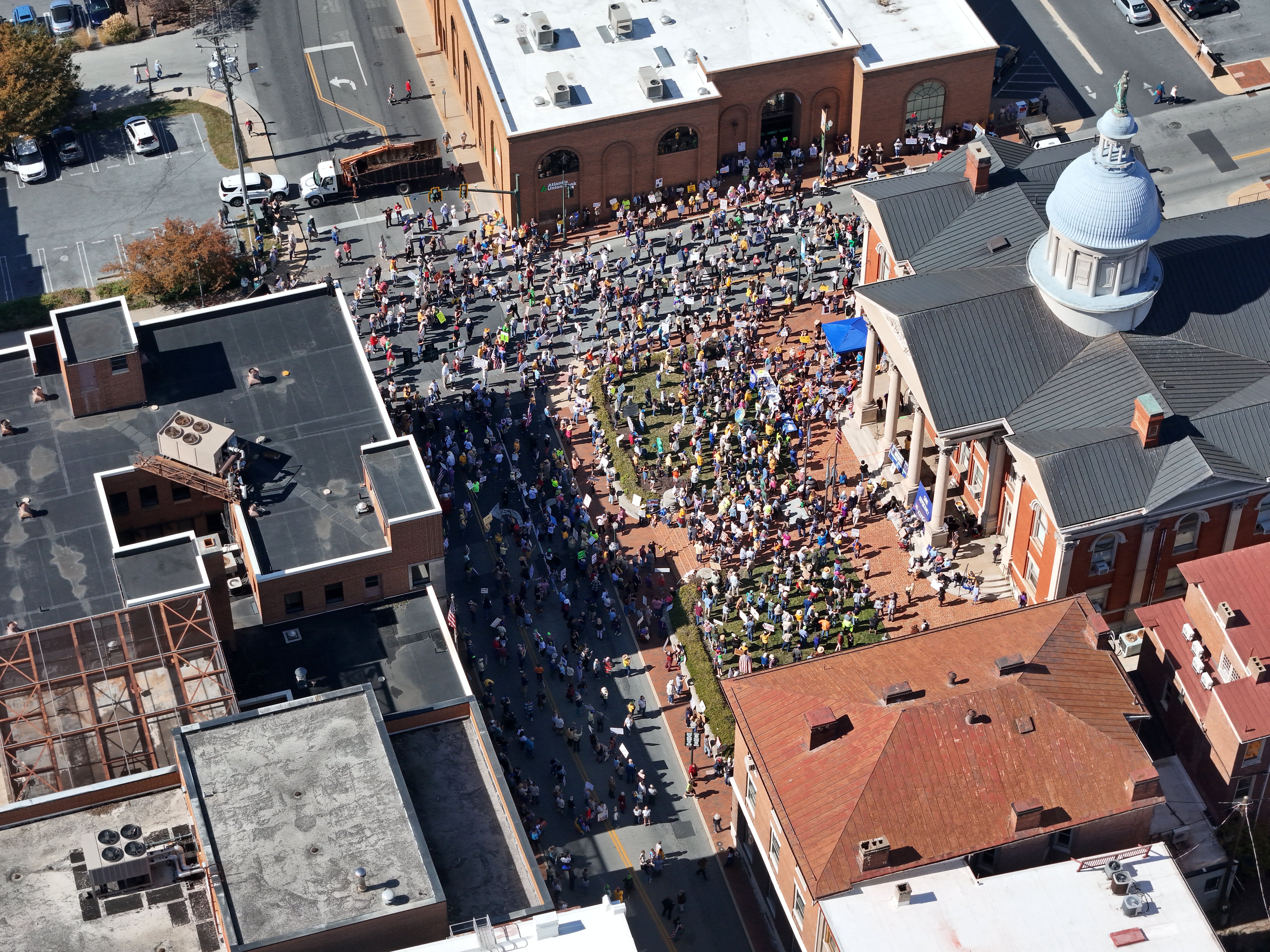
October 18, 2025 was the second time when “No Kings Day” events, demonstrating against the practices of the Trump administration, were held around the country. This was the second No Kings Day event, after an earlier day of similar events in June (I discussed the No Kings event in Baltimore that day). This event just happened to work out for me, as I had planned a trip to the Staunton area well in advance of my learning about this event, and it fell on the last day of my trip. So I decided to check it out. This was the day that I had planned to spend with Mom, so I took her along. I’m also pretty sure that this was Mom’s first protest since staying out all night for Cambodia when she was in college at Glassboro State during the Vietnam War era. The event was being held from 12:30 PM to 2 PM in front of the Augusta County Courthouse in downtown Staunton. Going into this, I had told Mom that I expected to see about 20-30 people at the courthouse, and a handful of counter-protesters across the street. In other words, I expected a pretty sedate affair, i.e. something that would be safe to bring your dog along for. If I had thought that it was going to be anything more intense than that, I wouldn’t have brought Mom with me. My plan was to take about 30-40 minutes to photograph everything and then keep it moving. I ended up being pleasantly surprised about the turnout, as there were a few hundred in attendance, and it not only filled the courthouse plaza, but also the streets immediately surrounding the courthouse. Staunton PD was there, but they were just directing traffic and maintaining the perimeter, with no presence inside the demonstration. And there were no counter-protesters to be found anywhere. It was still a perfectly safe bring-your-dog kind of protest – just a lot bigger than I had anticipated. And that was fine, because it just meant that there was more to photograph.
Categories: Activism, Family, National politics, Staunton
Refreshing an older photo set…
8 minute read
October 7, 2025, 4:32 PM
Recently, I gave a refresh to the “Afton Mountain: Victim of Progress” photo set from 2003. That’s the original Afton Mountain photo set, when all of the buildings were still largely intact (compare to the later “Afton Mountain: A Modern Ruin” from 2011). I gave a refresh to that set because I didn’t like the photo processing work on those images, and thought that I could do it better in the here and now.
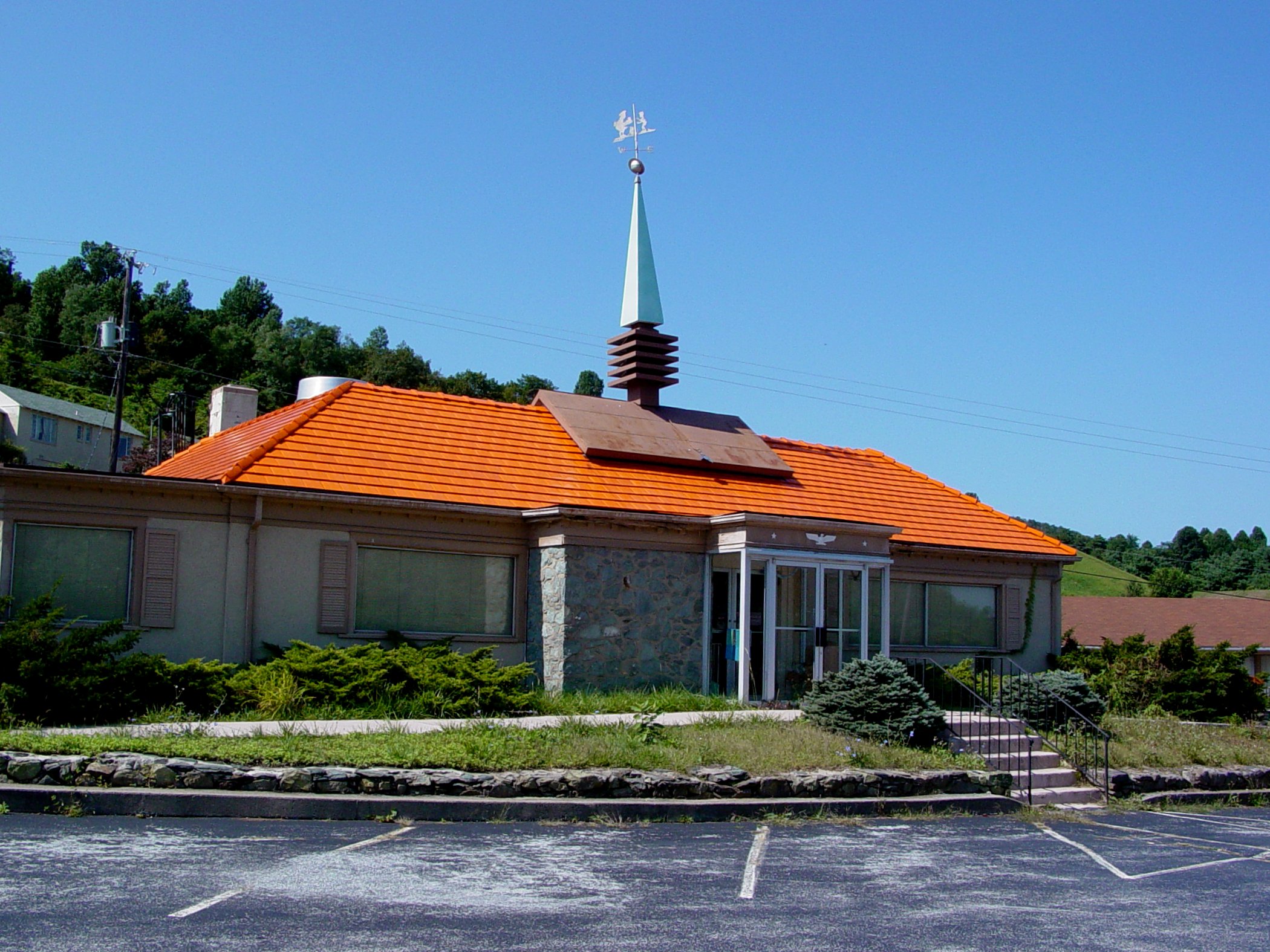
For some history, I shot those photos on September 10, 2003, and the set was released on November 3. Then in 2012, as part of the conversion of the entire site to WordPress, I reprocessed the photo set from the originals, along with all of my other photo work that was done prior to 2008. This was done in order to create production masters for those older sets, remove the watermarks that I had previously placed on those older photos, and also improve on my hideous editing work. However, for the Afton Mountain photo set, I inadvertently ended up making the new version of the photos a bit dark, and they ended up with a slightly blue cast on them. The originals had a slight yellow cast to them, so apparently I overcompensated when I tried to correct for that. Hey – nobody’s perfect.
Here’s a comparison using the lead shot in the set, showing the previous iteration of the photo set from 2012, and the refreshed version:
2012 revision.
Categories: Afton Mountain, Photography, Schumin Web meta