





The most ridiculous argument ever…
11 minute read
September 5, 2025, 5:26 PM
I was recently doing a search on my own Facebook posts to find something for the upcoming Life and Times photo set about my trip to Mobile, and I was struck by the fact that I had posted about one particular incident from 1994 three separate times:
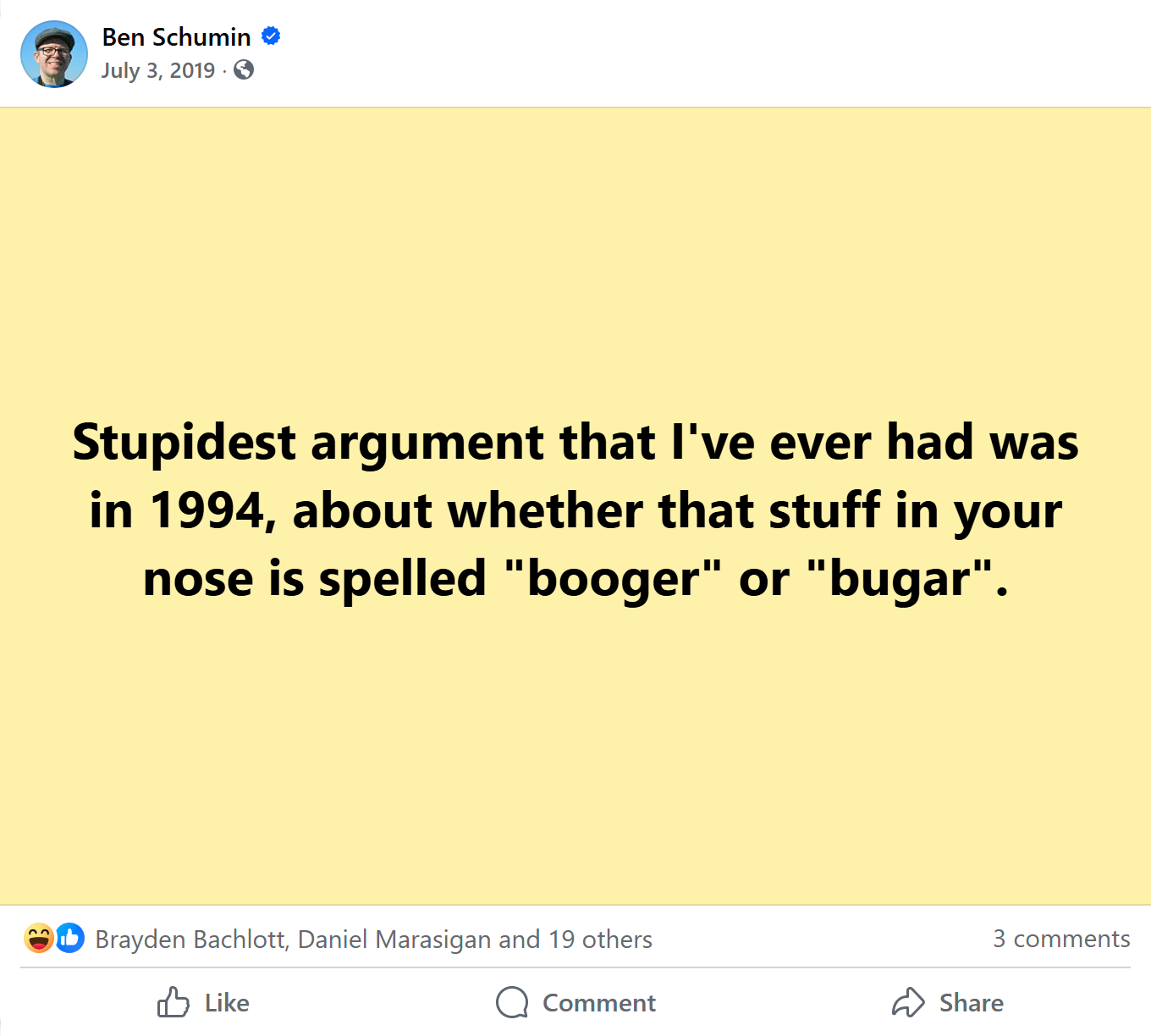
July 3, 2019.

July 11, 2019.

September 19, 2021.
Now, before we get started, yes, we’re about to have a serious discussion about the spelling of the word “booger”. So wipe that grin off of your face.
First, a little background. This was the second youth lock-in in as many years that Finley Memorial Presbyterian Church in Stuarts Draft did with the middle school youth group. The previous year’s lock-in was in the fall of 1992, and was themed around the topic of famine. As such, in that lock-in, which lasted a full 24 hours, there would be no food of any kind at the event, ostensibly to simulate famine, and the only thing that participants would be allowed to consume was fruit juice. I know nothing about how the famine lock-in went, because I passed on it, because that was not my idea of a good time. Looking back, I feel like the concept was reasonable enough, teaching these kids what famine was about, though the whole idea of fasting for 24 hours probably wasn’t a great analog to true famine. I appreciate that they wanted the kids to feel hunger in order to simulate famine, but it falls apart because of the difference between this and the real deal. With actual famine, after all, it’s long term, and people don’t necessarily know when their next meal is going to be, and if they do get to eat, who knows if it will be enough to sustain them. When you know ahead of time when it’s going to start, and also know from the outset that it’s only going to last 24 hours, you can plan and accommodate for that, like eating a really big meal right beforehand, and then eating another big meal afterward in order to recenter yourself. That’s not famine. That’s a 24-hour fast.
Apparently, the famine lock-in didn’t go over particularly well, because the following year’s lock-in, which would occur in January 1994, would have food, and we were reassured multiple times that there would be food. It didn’t have an overarching theme, but it would run a full 24 hours, from 8 PM on Friday to 8 PM on Saturday, just like the famine one did. It was a pretty fun event, with one of the Sunday school rooms containing an entire table full of junk food, which everyone had a hand in contributing to. There was so much food, and almost none of it was healthy (I believe that we also had pizza, which at least had some redeeming nutritional value). So many opportunities to make very bad nutritional choices, with all sorts of chips and cookies and candies and sodas and the like in there. The minister was the leader of the lock-in, and he led us through various activities, both structured and unstructured, throughout the evening and the next day. I remember that before going to church for the lock-in, Mom and I went to the Rack & Sack store in Staunton to get my contribution to the junk food pile, and while we were there, I bought a copy of Electronic Gaming Monthly‘s 1994 Video Game Buyers Guide. I remember having time to sit and read some of it during the lock-in, so it wasn’t entirely structured, which was good. I want to say that we had about ten or so people participating, which was pretty typical attendance for the middle school youth group at that time, as Finley Memorial was and still is a small church. In the evening, we were up well past midnight, and I’m pretty sure that it wasn’t until after 2:00 AM that we finally got to sleep, and then we woke up some time in the mid-to-late morning.
I got the sense that the minister had bitten off a bit more than he was willing to chew in planning this one. We had fun and didn’t do anything that would get anyone into trouble, but a bunch of kids between 11 and 13 years old and only one adult was a lot to deal with. The activities were less about religion and more about keeping the group entertained, but it was fun all the same. I got the sense that the minister started this lock-in with the best of intentions, but I got the sense that his patience wasn’t as long as the lock-in was scheduled to run, and I sensed that he was getting somewhat irritable in the back half of the lock-in. For about four hours towards the end of the event, we had another congregant, who had something of an unofficial leadership role in the church, watching over us and helping to keep us entertained during the final stretch while the minister attended to some matters offsite. I don’t know what the matters were, but I suspect that he just needed a break from us for a while. When he returned later, he was in a much better mood, which told me that a respite from us was probably exactly what he needed. And I don’t blame him, because we were all fired up and full of sugar. We never had another lock-in while I was involved in youth group, and I don’t blame anyone for not wanting to it again, because while it was fun, a good time was had by all of us kids, and no scandals emerged from it, it was basically a giant slumber party more than anything else. We had plenty of all-day activities in later years, but never another lock-in or other overnight activity, which is fair enough. In other words, I completely sympathize with the writer of the article that I linked on the second Facebook post about why youth lock-ins are for the birds. I sure as hell wouldn’t voluntarily put myself in that situation, tasked with being the only adult supervising a bunch of overcaffeinated middle schoolers running around a church building for 24 hours.
So what does all of this have to do with the argument? Some time in the afternoon towards the end of the event, after we had all been together for about 18-20 hours, a girl named Leigh Ann had drawn a picture on a whiteboard of a boy picking his nose, with the caption, “Nobody better lay a finger on my bugarfinger!” which parodied the then-popular “Nobody better lay a finger on my Butterfinger!” phrase that Bart Simpson used as a tagline in commercials for Butterfinger candy bars. It was a good drawing (better than I could do by quite a bit), and I was amused by it, because body function humor is my kind of humor (just ask Elyse). However, my eye immediately locked onto that spelling of “booger”, spelled very similar to “sugar”, and recognized that the spelling that Leigh Ann had used was incorrect. I take after my mother in this way, as, like her, I tend to be a bit of a stickler for spelling and grammar and will point out (and sometimes vigilante correct) errors. When someone says “had went,” my usual response is a correction, saying, “Went stands alone.” A third kid, a guy named Jeff, walked in on our discussion and joined us, suggesting a third spelling, “buger”.
What followed was extremely amusing in hindsight, as we all made very reasoned and impassioned arguments about why our preferred spelling of those tasty little morsels that you find in your nose was the correct one. I staunchly defended the spelling of the word as B-O-O-G-E-R, Leigh Ann passionately defended the spelling as B-U-G-A-R (which I pronounced as “BOO-gahr” so as to emphasize the incorrectness of the spelling), and Jeff advocated for B-U-G-E-R. I want to say that this argument over the spelling of “booger” ultimately ended in a stalemate, as we all eventually realized that we weren’t going to convince the others of which spelling was correct, and just kind of let it go. After all, we were at church. As such, we didn’t have access to a regular dictionary, but even then, there was no guarantee that “booger” would even be in there, as many smaller dictionaries skipped a lot of fun words. We had a lot of Bibles to refer to, but unfortunately, the Bible doesn’t mention boogers once in any of its 66 books. It was also January 1994, which meant that there was no Internet, no Google, and certainly no smartphones. So with no real ways to access external documentation and conclusively settle the matter, Leigh Ann, Jeff, and I each left that argument thinking that we were right. I could have probably put the argument to bed on the spot if I had my copy of The Essential Calvin and Hobbes with me, as there is an early strip where Calvin walks outside on a snowy day, makes a face, and then turns to the audience and says, “Don’t you hate it when your boogers freeze?” I could be like, “There you go. Print evidence of ‘booger’ spelled the way that I claim that it is.” As it turned out, the world has proven me correct (go look it up yourself), and I imagine that Leigh Ann and Jeff eventually came around.
I suppose that it also speaks to the weirdness of the English language, because all three spellings are completely reasonable, and all three will lead you to the intended pronunciation, even if two of them were not the generally accepted spelling, then as now. One of the hallmarks of the English language is how irregular it is, with letters’ taking different sounds depending on context, words that sound exactly the same but are spelled differently and have different meanings, words that are spelled the same but pronounced differently and have different meanings, many different ways to conjugate verbs, etc. It reminds me of the term “ghoti“, which is pronounced “fish”. It takes the “gh” that makes an “F” sound as in “enough”, the “o” being pronounced like a short “I” as in “women”, and “ti” being pronounced like “sh” as in “action”. Then there are verbs, where words with similar spellings and pronunciations in their infinitive form, e.g. “to give” and “to live”, take very different forms when you conjugate them. For “give”, you say, “I give you five dollars,” in the present tense, but for the preterite tense, it becomes, “I gave you five dollars,” while it is “I have given you five dollars,” in the present perfect tense. So, give, gave, given. Cool. However, with “live”, it’s “I live in this house,” then “I lived in this house,” and “I have lived in this house.” Live, lived, lived, and not live, lave, liven. But it would be completely reasonable, even if incorrect, if someone said, “I gived you five dollars,” or, “I have liven in this house,” because the other words behave as they do. In other words, you get caught saying something wrong, and you point at the other word and say, “Well, he’s doing it!” It’s reasonable. Wrong, but reasonable.
It also makes me glad that I was raised as a native English speaker. All of the weirdness of English just comes naturally, since for many years, it was all that I knew, and my mother was always quick to correct me whenever I would use words incorrectly. Trust me when I say that when I say “Went stands alone,” I am absolutely channeling my mother, who is kind of proud to have passed that along and instilled that in me. Learning some other languages gave me an appreciation for being a native English speaker, because some other languages are far more structured and rule-abiding than English. I took Spanish and Latin in high school, and they were relatively easy to learn because they followed the rules.
In Spanish, for instance, all verbs end in either -ar, -er, or -ir. And then, for the most part, they conjugate in a very predictable way, changing the word endings depending on the person and number of people involved. Take “aceptar”, for instance, which means “to accept”:
- Acepto, singular first person (yo), “I accept”
- Aceptas, singular second person (tú), “You accept”
- Acepta, singular third person/usted, “He/she accepts”
- Aceptamos, plural first person (nosotros), “We accept”
- Aceptaís, plural second person (vosotros), “Y’all accept”
- Aceptan, plural third person/ustedes, “They accept”
Then there’s “aprender”, which means “to learn”:
- Aprendo, singular first person (yo), “I learn”
- Aprendes, singular second person (tú), “You learn”
- Aprende, singular third person/usted, “He/she learns”
- Aprendemos, plural first person (nosotros), “We learn”
- Aprendeís, plural second person (vosotros), “Y’all learn”
- Aprenden, plural third person/ustedes, “They learn”
Pretty similar. Here’s “recibir”, which means “to receive”:
- Recibo, singular first person (yo), “I receive”
- Recibes, singular second person (tú), “You receive”
- Recibe, singular third person/usted, “He/she receives”
- Recibimos, plural first person (nosotros), “We receive”
- Recibís, plural second person (vosotros), “Y’all receive”
- Reciben, plural third person/ustedes, “They receive”
(As a quick aside, note that “vosotros” is not commonly used outside of Spain, and thus why you probably learned “ustedes” for the y’all form in Spanish class instead of “vosotros”.)
And even a lot of verbs with oddities in them are fairly easy to predict. Like a verb that ends in -cer such as “conocer” (to know, such as a person), the yo form will always add a “z” to it in order to retain that soft “c” sound when the presence of the “o” after it would dictate a hard “c” sound. Thus rather than “conoco”, for first person, it becomes “conozco” to correct that hard “c” problem. Likewise, a lot of verbs with an “o” as their second character will replace that “o” with a “ue” in all forms except for nosotros and vosotros (we called these “shoe verbs” in Spanish class). For instance, here’s “poder”, which means “to be able to” or “can”:
- Puedo, singular first person (yo), “I can”
- Puedes, singular second person (tú), “You can”
- Puede, singular third person/usted, “He/she can”
- Podemos, plural first person (nosotros), “We can”
- Podeís, plural second person (vosotros), “Y’all can”
- Pueden, plural third person/ustedes, “They can”
Very predictable. And most English speakers who took Spanish probably know “poder” from the term “¿Puedo ir al baño?” i.e. “Can I go to the bathroom?” which is a very important phrase if nature calls while you’re in Spanish class.
Additionally, Spanish is largely only pronounced one way. Any differences in pronunciation, like with “conocer”, are done with spelling changes or diacritical marks. I appreciate that the words tell you exactly how to pronounce them. There’s no “I have had enough of my ghetto neighbor,” in Spanish, where that “gh” digraph appears three times in my example, but each one is pronounced differently from the others. The only thing that I got hung up with in Spanish was gendered nouns, since Spanish had no neuter gender, meaning that every noun was gendered regardless of anything. Cue the meme that says, “Me during my French exam wondering what is the gender of a washing machine.” I just couldn’t wrap my mind around the idea that a gender was forced on an inanimate object, because we don’t do that in English, where inanimate objects are in the neuter gender, and the only gendered nouns are limited to terms for things that actually have genders. And for what it’s worth, according to Google, “washing machine” in Spanish can be masculine or feminine depending on which term you use for it, with the feminine “la lavadora” (which is what we learned in Spanish class) and the masculine “el lavarropas”.
But that’s the thing about Spanish: once you get a feel for it, it’s easy to run with. Since graduating from high school, I lost most of the Spanish vocabulary that I had learned in school, but I remember all of the grammatical rules, because that’s just how my little autistic brain works. So while I cannot hold a conversation in Spanish, I could talk about Spanish grammar all day. I can also make a Spanish-esque sentence, where I follow all of the grammatical rules but make up my own words. For instance, I could say, “El drono están flyando al mallo de Staunton,” which would translate to “The drone is flying to Staunton Mall,” from whatever mutant Spanish that was. But you get the point. All of the proper grammatical rules are followed, but I don’t know many of the actual words anymore. Such is what happens when you don’t use it.
Latin is the same way. Everything is very predictable, even more so than Spanish, though the grammatical rules differ somewhat, like how the verb comes last in Latin, and nouns are declined similarly to the way that verbs are conjugated, with different endings to indicate their role in the sentence. And like Spanish, I remember very few of the actual words, though perhaps a bit more than Spanish because of how many English words derive from Latin, but I could grammar you to death. Remember that mutant Spanish sentence that I did earlier? I can do I can do the same with Latin, saying something like, “Caecilius cookium eatat,” which is mutant Latin for “Caecilius is eating a cookie.” Grammatical rules followed, but the words are English made to look like proper Latin. Meanwhile, anyone who studied Latin with the Cambridge Latin Course knows exactly who Caecilius is (“Caecilius est pater,” after all).
So there you go, I suppose. The English language is weird, and as such, there are lots of things that are reasonable, but all the same incorrect. And in the days before the Internet and smartphones, with no way to quickly look things up, it was easy to get into very impassioned arguments over easily verifiable things, just because we didn’t have the means of verifying it and showing everyone on the spot. Thus we had to resort to simply making our case for our audience for verifiable facts. And I will remember the youth group lock-in forever as a fun experience that can never be repeated.
Categories: Church, Language, Stuarts Draft
Leave a Reply