
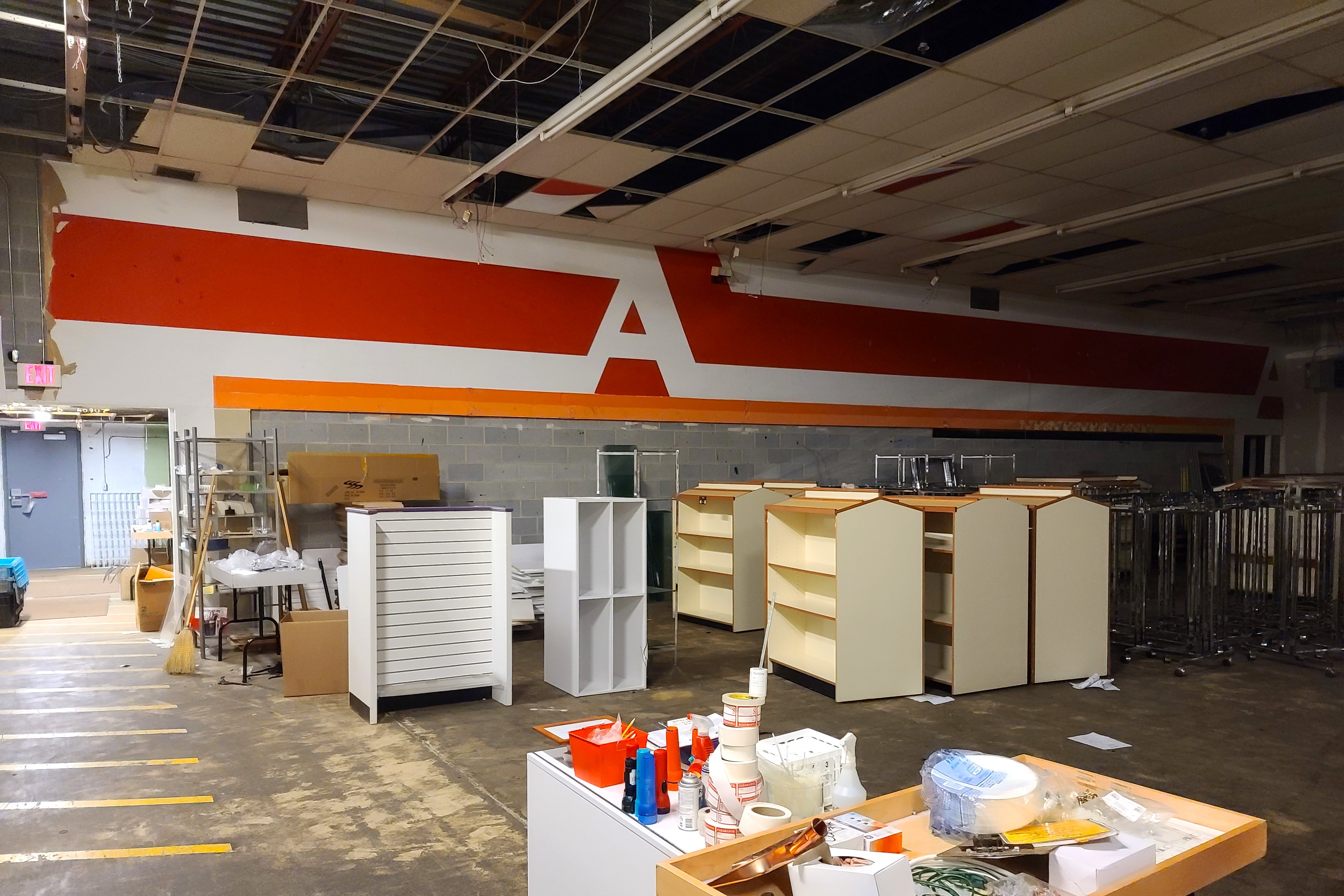
Recently, while I was browsing Facebook, I found a post by a page called Remembering Retail, which focuses on retail-related nostalgia of various types. I have been familiar with this page for a while, as Facebook serves it up to me on a regular basis, despite that I have never formally followed it. In this particular instance, the post discussed Ames, a now-defunct discount store. The photo that accompanied the post was this one from my visit to the Gordmans store in Waynesboro, Pennsylvania on August 20, 2020:
The information about Ames was interesting enough, though in reading through it all, one thing that caught my attention was that the page author provided attribution to a person named Stephan Mynarkiewicz for bringing the photo to their attention. I couldn’t help but think that Mynarkiewicz had nothing to do with the creation or publication of that photo, so he should not receive any attribution. However, what that attribution told me was that the page author really didn’t care where the photo came from, since they thanked the person who previously stole it and then presented the purloined content to them, rather than providing attribution to the person who took the photo, i.e. thanks for nothing. Though note that attribution doesn’t have much relevance here, because for content made after February 2014, I require explicit permission for reuse regardless of the purpose, except under very limited circumstances. According to my content licensing page, “Individuals are extended a blanket license to use content on The Schumin Web for personal, noncommercial purposes without receiving explicit written permission. An example of such usage is a desktop background on a personal computer or phone. This blanket license does not extend to any form of public exhibition, including rehosting on social media sites[.]” Anything else needs explicit permission from me in order to be considered legal, including all public exhibition.
With this in mind, I made use of the remedies available to me. In evaluating this one, I didn’t see this as a case that was suitable for resolution through Pixsy, as the page appeared to be run by an individual. So I filed a DMCA takedown notice through Facebook, and they processed it a few days later. As far as I was concerned, the problem was solved, as the infringing content was blown off of the Internet.
I later got an email from the page author for Remembering Retail, and here’s what they had to say:
Good morning,
I must admit I found this somewhat shocking on a multitude of levels.
1. What was shared with me by one of my followers has no mention of you, no mention of anyone within it.
2. This is a visible stockroom that anyone can take a picture of and many have. In the comments, it was revealed this is still present. It was my understanding that this came from Reddit, so the “cat was out of the bag”, so to speak. Things like this are easily replicated, and you will likely have a hard time going after people as it literally becomes an angle game. I’d question whether you should.
This is a tight-knit community in many ways, and that’s not exactly a great way to make friends within it, and I say that as someone who has plenty of enemies within it. I’ve got no problem going back to Waynesboro and taking a similar shot of this myself, and would have that day had I known it was present. My focus was on the closing Rite Aid itself and seeing the status of the mall within itself that day led to people providing more of the context around things.
3. You yourself have commented and participated in page discussions, even as recently as this month that I’ve seen. I believed you to be a follower of the page. It’s a little alarming to me that you’d go straight to Facebook before commenting regarding attribution, which I could have easily provided you had you said this was your photo or provided evidence of it being your photo, and have done for many others. Actions like these make me feel as if even the page’s followers cannot be trusted as submissions against the page like this do put it at risk of being shut down and restricted. I’ve recently had people try and claim photos are their own when they’re clearly not, this was a far more cut and dry case that could have easily been resolved without going into the system.
I do the best I can with what I’m given to try to make the page exciting, engaging and interactive for its many followers. One of the many things I’ve tried to do is encourage people to provide content for the page to broaden its impact and geographic scope beyond where I can realistically visit, and also to provide historical information and documentation beyond what can be achieved in 2025. It makes it very hard to do that with submissions against the page like this.
Thank you,
Remembering Retail
I quickly got the sense that this was the work of a retail enthusiast who was just trying to share interesting content about retail, and had no clue about copyright, and why it is important to respect copyrights (and they should probably give 10 Big Myths about copyright explained a read). I also sensed that they were very salty about getting caught, i.e. that they were just doing their thing, pulling photos from wherever, and then the fun police came by and stopped them.
There’s a lot to unpack here, and it deserves analyzing, because while they gave a lot of excuses and/or justifications for what they did, most of them are barely relevant to the infraction being addressed, if at all, but which still deserve discussion in order to properly debunk them and hopefully prevent others from making the same mistakes that this person did.
Right offhand, the page author’s first point, “What was shared with me by one of my followers has no mention of you, no mention of anyone within it,” has no relevance to the situation, since they didn’t receive the requisite permission to publish in the first place. In other words, providing attribution for a copyrighted image where permission was not received does not make everything legal, but rather, it’s simply an advertisement of who they stole the image from. It’s nice to acknowledge where the content that you just pinched came from, but it’s still stealing all the same. However, I was somewhat insulted that they had given credit to Stephan Mynarkiewicz for being the first to steal it and then passing it along to them to display. If you’re going to steal from me, at least attribute me as the victim of your theft. It’s not going to prevent me from filing a DMCA takedown notice or referring it to Pixsy, but to not provide any attribution is just rude, and nobody likes a rude individual.
The page author’s next point, where they said, “This is a visible stockroom that anyone can take a picture of and many have. In the comments, it was revealed this is still present,” is similarly a nonstarter, and probably inaccurate. If it’s something that is so visible and so frequently photographed, why is my photo of it the only one that has made the rounds? It sounds like no one else has captured it but me. Also, you want to know how people know that the Ames wall decor is still present? That’s also because of me. Elyse and I went back there after the space had been leased to a new tenant (Burkes Outlet, later renamed to Bealls) and we showed the employees the photo from the Gordmans closing sale, and asked them point blank if that Ames decor was still there, and they said yes. Then we reported back on some of the other retail spaces online, and that word spread. No need to thank me.
It’s also worth noting that this back room space is not as visible as the page author might think. My photo was taken during a complete liquidation of the entire company, where everything that was in the building that wasn’t bolted down was being sold to pay off debt. In those kinds of situations, I have no qualms about walking right into a store’s back rooms and wandering around, ostensibly in order to see if there are any fixtures that I might want to purchase (but I’m really going back there just to snoop). In other words, I wasn’t standing on the salesfloor and photographing through a doorway. I was all the way in the back room, looking for fixture deals. If you wandered back there now that Bealls is leasing the space and is still functioning as a going concern, I’ll bet that they would walk you right back out of there in short order.
The next thing that they said was that because the image was posted to Reddit (here), the “cat was out of the bag”. That is accurate to an extent. Once a photo is published somewhere and out in the wild, they sometimes develop a life of their own, making their way all around the world, hobnobbing with photos taken by people who produce waaaaaaaaay better work than me, and sometimes even standing in for other subjects (you wouldn’t believe how many different shopping centers that my photo of Pentagon City Mall has been purported to be in photo captions over the years). And the thing is, regardless of how much these photos may travel, reuse still requires my permission. I don’t care if a photo has been posted to Reddit, Facebook, Threads, Bluesky, or anywhere else. The copyright that I hold in that photo remains intact unless I explicitly give it up. It is very much not “Well, it’s on the Internet, therefore it’s free to use.”
I was also somewhat amused by the remark about identification of the content, when they said, “Things like this are easily replicated, and you will likely have a hard time going after people as it literally becomes an angle game. I’d question whether you should.” You would be surprised at how easy it is to identify a specific photo if you know what to look for, and I am pretty skilled at doing so. To my knowledge, the only person who took a photo of this back room under Gordmans’ stewardship was me, and maybe also Elyse. And at the time, the store was in liquidation, which the photo reflects. If one were to come back now and photograph it from the same angle under Bealls’ stewardship, I can’t imagine that the room would look the same, as it would contain different fixtures, merchandise, etc. after Gordmans vacated and Bealls moved in. And even if the room was furnished exactly the same way, it is impossible to take the exact same photo twice. There is always something different between two shots, even if it’s something incredibly minor.
Then there was the community aspect of the response, where they told me that retail enthusiasts are a tight community, and copyright claims are not a good way to make friends. Trust and believe that I am not there to make friends. The way that I’ve observed a lot of them behaving, I don’t want to be friends with a good amount of them. But none of that has anything to do with the price of tea in China as far as copyright infringement is concerned.
But one thing that they said was that they would have no problem going back to Waynesboro and taking a similar shot of the space, to which I would just respond, “But you didn’t.” After all, if they were capable of going back, they could have waited until they had gone back to publish their own shot of the same subject. Instead, they pinched mine in violation of copyright and ran with it.
Then they went on to indicate that they were salty about what happened, while attempting to verbally lick their wounds. First, they reminded me that I have commented and participated in page discussions. That is accurate. I have participated, though I have never formally been a follower of the page. But that has no bearing on the matter of copyright infringement. To me, it comes off as, “I thought you were my friend!” And for what it’s worth, no, if you steal my work, I am most definitely not your friend, and I do not play around when it comes to copyright infringement. Then there’s the idea that I should have come to them directly to resolve the matter rather than going through formal channels. I hear that every time someone gets caught stealing and gets mad about it. My reasoning for going straight to the formal channels is simple: I had to listen to all of that whining about the infringement after the problem has been solved, so why would I want to hear whining while I’m trying to get them to solve a problem? And then if they won’t address it themselves (a real possibility), I still have to go through the formal channels anyway, so I see no reason to take an intermediate step vs. going straight to the formal channels. Then the problem is solved quickly and simply, no muss, no fuss.
Additionally, infringing parties never consider this: why should I trust them to remove infringing content to begin with? After all, they have already demonstrated that they are unwilling to respect copyright. I have zero reason to think that they will do as I ask, especially seeing as it doesn’t benefit them.
Their next argument was that these sorts of actions make them feel as though they can’t trust their page’s followers, and that submissions against the page put it at risk of being closed down and/or restricted. Projection, much? From where I’m standing, it seems more like they can’t be trusted to respect copyright, and so I have to do what I need to do in order to protect myself from them. And if the page gets shut down and/or restricted on account of that? Let me play you a sad song on the world’s smallest violin. After all, they made their own bed, and it’s not my fault if they don’t like it when they have to lie in it.
They also seem to be a bit misguided in their thought process when they say, “It’s a little alarming to me that you’d go straight to Facebook before commenting regarding attribution, which I could have easily provided you had you said this was your photo or provided evidence of it being your photo, and have done for many others.” That’s not how it works. Attribution is something that I require of a downstream user after I give them permission to use the content. That is not something that a downstream user imposes on me, and I do not go around begging for it after my photo has already been used without my permission. It’s also worth noting that how I handle these things really depends on what order things happen in. If a potential downstreal user comes to me beforehand and asks to use something, I am usually pretty amicable. I love seeing my work being used in other publications, but I’m a stickler for process and procedure. For a page like Remembering Retail, if they had asked me first before publishing, I would have probably given them permission, with the requirement that a byline be provided with the photo. But since they didn’t ask me first, then the hell with them – I nailed them for copyright infringement.
Then in their last point, they said, “I do the best I can with what I’m given to try to make the page exciting, engaging and interactive for its many followers. One of the many things I’ve tried to do is encourage people to provide content for the page to broaden its impact and geographic scope beyond where I can realistically visit, and also to provide historical information and documentation beyond what can be achieved in 2025.” None of that absolves anyone of the responsibility of ensuring that content is not being used in violation of anyone’s intellectual property rights. Yes, it requires a bit of extra effort before publication, but it ensures that you don’t have any issues down the road when people whose toes that you stepped on along the way come looking for their piece of the pie. It’s kind of like the argument that people make where they say, “I worked very hard on this,” about something that ended up producing poor results. Hard work does not equal good work. Trust me on this one, because I know, as I’ve worked very hard to end up with very crappy results in the past. And if that’s the best that they can do with what they are given, then, as Jon Taffer once said, “So the best you can do sucks.”
And then to finish it off, they signed their correspondence as “Remembering Retail”. That just came off as cowardly, as they decided to hide behind their Facebook page. As far as I’m concerned, this is business. People in business have names, so use it. Even the time when I was contacted by an attorney about a copyright infringement involving someone who had used a different name professionally, the attorney referenced their client by their legal name and then the name that they used professionally.
In looking over all of this, I am reminded of one very important thing: everyone wants to be treated like an adult, right up until the moment that someone actually treats them like an adult. Then they pitch a fit about it, because it’s not fair that they had to face actual consequences over their actions, despite that they were the ones that made the choice that led to the consequences. It makes me think of JMU and their policy about underage consumption of alcohol during the time that I was a student there. The university took underage drinking pretty seriously, and as such, if a student accumulated three alcohol violations during their time as a student, they would be suspended for a minimum of one semester. These were colloquially known as “strikes”. I remember that there was a discussion somewhere, I believe as a series of letters to the editor in The Breeze, where one person said that they wished that students would receive some kind of warning about alcohol consumption before a “strike” is issued. Then one of the former RAs from my freshman dorm wrote back and said that those “strikes” were your warning. And they were right. JMU could have suspended someone for a semester on the first alcohol violation, but by allowing three, you got two warnings before they tossed you. And before it would get to the point of earning that third “strike”, they made sure that you knew the gravity about what you were getting into, including notifying parents, even though these students are legally adults (and before anyone starts wondering, no, I do not know all about this from experience).
The same principle applies to copyright and DMCAs. My DMCA takedown notice is like an alcohol violation. It’s processed, and the violator gets a “strike”, which effectively serves as a warning that they are going down a bad path. When they accumulate enough “strikes” on a platform, their account is removed. I am not privy to how many “strikes” a person has on a given platform when I file a takedown notice, but if my DMCA takedown is what gets someone’s account removed, that means that they had a trail of previous violations, and the service provider finally said that enough was enough and pulled the plug on their account. I remember one time, a DMCA that I filed got a Twitter account zapped that belonged to someone with over 100,000 followers. I got flamed pretty heavily for that, which amused me, because at the end of the day, I wasn’t the one who did anything wrong. I was the victim, and not the bad guy, and so it’s hard to blame me for taking the actions that I determine to be necessary to protect my own interests.
All of this boils down to a very simple concept: don’t steal. If you ask me up front for permission to use content that I have published, I’m usually fine with it. But you have to ask me first. If you go around me and use my content without permission and then I catch you, I am not nearly so nice about it. I don’t like filing DMCA takedowns, and there are a thousand other things that I would rather do than file DMCAs, but if I need to file one, I will.